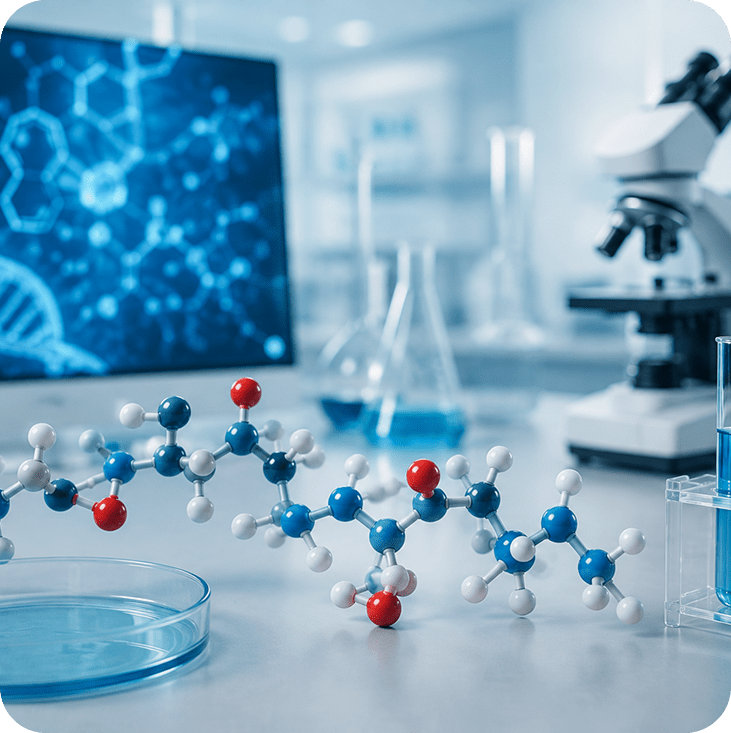
Peptide research can be complex. We make it easier to understand by breaking down scientific concepts, study methods, research findings, and safety considerations into clear, accessible information.
Research Is Easier To Understand When It's Explained Clearly
Our goal is to provide transparency and clarity in an often confusing landscape.
Clear Explanations
Complex scientific terminology translated into plain, understandable language.
Research Context
Understanding where a study fits within the broader landscape of current research.
Evidence Awareness
Learning to distinguish between preliminary findings and established facts.
Safety Perspective
Evaluating the potential risks alongside the theoretical benefits of compounds.
Start With The Basics.
At their core, peptides are short chains of amino acids—the building blocks of proteins. Think of them as precise biological messengers that tell the body to perform specific functions.
In research, scientists isolate or synthesize these chains to study how they might influence everything from cellular repair and inflammation to metabolic processes. Understanding this signaling mechanism is the first step in understanding peptide research.
In research, scientists isolate or synthesize these chains to study how they might influence everything from cellular repair and inflammation to metabolic processes. Understanding this signaling mechanism is the first step in understanding peptide research.
Naturally occurring vs. Synthetic variations.
Targeted vs. Systemic cellular interactions.
Current focus areas in veterinary & biological science.
The scientific method is a rigorous, step-by-step process designed to minimize bias and uncover truth.
The Question
Researchers observe a phenomenon and form a specific, testable hypothesis about a peptide’s effect.
Study Design
Creating a structured environment to test the hypothesis, selecting subjects, controls, and variables.
Data Collection
Executing the study under strict protocols to gather measurable, objective data points.
Analysis
Using statistical tools to evaluate the data, determining if results are significant or due to chance.
Interpretation
Drawing conclusions based strictly on the analyzed data, while acknowledging the study’s limitations.
Further Research
Publishing findings for peer review, leading to replication studies or new hypotheses.
Not All Research Provides The Same Level Of Evidence.
Understanding the setting of a study is crucial to understanding how its results should be interpreted.
In Vitro Studies
In Glass
Research conducted outside a living organism, typically in test tubes or petri dishes using isolated cells or biological molecules.
Value: Great for establishing basic mechanisms and preliminary toxicity.
Limitation: Cells in a dish do not behave exactly like cells in a complex, living body.
In Vivo (Animal)
Pre-Clinical
Studies conducted within living animal models to observe complex systemic interactions and side effects before human testing.
Value: Shows how a compound interacts with a complete biological system.
Limitation: Animal physiology differs from humans; success here does not guarantee success later.
Clinical Trials
Human Studies
Carefully controlled studies involving human volunteers to evaluate safety, efficacy, and optimal dosing regimens.
Value: The highest standard of evidence for real-world application and safety.
Note: The highest standard of evidence for real-world application and safety.
Good Education Includes What We Don't Know Yet.
In scientific research, uncertainty is a feature, not a bug. Understanding the limitations of current data is vital for responsible interpretation.
The Novelty Factor
Many peptides currently researched are relatively new. While short-term studies might show promise, long-term safety profiles (effects over years or decades) are often entirely unknown.
Risk vs. Reward Ratio
Every intervention has potential side effects. Research aims to map these out, but early studies may not capture rare or compounding adverse events.
Frequently Asked Questions
What are peptides?
Peptides are short chains of amino acids linked by peptide bonds. They are smaller than proteins and occur naturally in the body, where they perform a wide variety of essential signaling and regulatory functions.
Is this medical advice?
No. The information provided is strictly for educational and research purposes. It is not intended to diagnose, treat, cure, or prevent any disease. Always consult with a qualified healthcare professional regarding medical decisions.
Why is in vivo research important?
In vivo (animal) research allows scientists to observe how a compound interacts within a complex, living biological system, revealing potential systemic effects and preliminary safety data that cannot be seen in isolated cells (in vitro).
Learn first. Decide when you're ready.
There’s no pressure here just research, explained clearly, at your pace.